
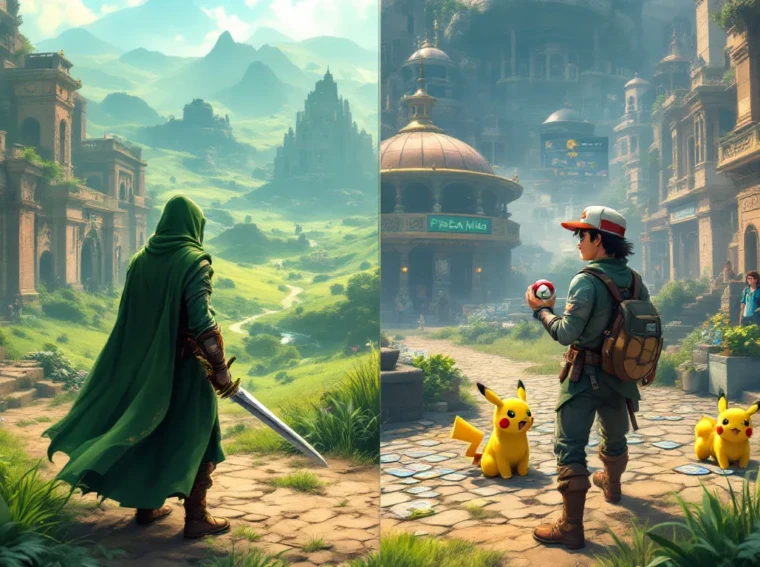
Ask any gamer what franchises define Nintendo, and two names will inevitably rise to the top: The Legend of Zelda and Pokémon. For decades, these series have operated in different lanes, one a masterclass in adventure and puzzle-solving, the other a phenomenon that transcended gaming entirely. But their parallel evolution reveals something deeper: both shaped not just Nintendo’s identity, but modern gaming itself. In 2026, as the industry navigates open worlds, live service models, and player expectations set by these very franchises, understanding their impact isn’t just nostalgic. It’s essential to understanding where games are headed. Both Zelda and Pokémon started humble, on limited hardware, with straightforward goals. Yet they’ve grown into cultural institutions that have influenced everything from indie darlings to AAA blockbusters. This isn’t a rivalry, it’s a story of two titans that took different paths toward the same goal: creating worlds worth exploring and mechanics worth mastering.
Key Takeaways
- The Legend of Zelda and Pokémon shaped modern gaming through distinct philosophies: Zelda through puzzle-solving exploration and player agency, Pokémon through collection mechanics and competitive community building.
- Breath of the Wild revolutionized open-world design by removing mandatory progression gates, proving that true player freedom and exploration could coexist with meaningful challenges.
- Pokémon’s transmedia strategy—combining games, trading cards, anime, and toys into an integrated ecosystem—established the blueprint for cross-media franchise success that countless games now follow.
- Both franchises prioritize intuitive, scalable design that accommodates casual and competitive players simultaneously, from type advantages in Pokémon to Zelda’s hierarchical puzzle structure.
- Zelda builds worlds through environment and silent storytelling, while Pokémon builds through character relationships and community engagement, demonstrating that narrative depth doesn’t require cutscenes.
- Iconic art direction matters more than technical realism for franchise longevity—Zelda’s stylized designs and Pokémon’s instantly recognizable character silhouettes have outlasted photorealistic competitors.
The Origins Of Two Gaming Titans
The Legend Of Zelda’s Pioneering Legacy
When The Legend of Zelda launched in 1986 on the NES, adventure games didn’t exist as we know them today. The original game, developed by Shigeru Miyamoto and his team at Nintendo, broke convention by offering players a world to explore, dungeons to solve, and secrets to discover, all without a single cutscene or narrative exposition. Link didn’t have voiced dialogue. The world didn’t explain itself. Instead, the game trusted players to explore, experiment, and fail without hand-holding.
This was radical. Most games of the era were linear, level-based experiences. Zelda gave players agency. It introduced the concept of the “dungeon key”, a puzzle item that locked progression but encouraged backtracking and exploration. Across NES, SNES, N64, and GameCube, the franchise evolved but retained this core principle: adventure through exploration, clarity through intelligent design.
A Link to the Past (1991) perfected the formula on SNES, offering a massive overworld packed with secrets and two interconnected dungeons. Ocarina of Time (1998) brought Zelda into 3D, and while the camera became infamous, the game’s dungeon design and puzzle logic set the standard for 3D adventure games that studios still follow today. Each entry felt like a statement: games could be art, could tell stories without cutscenes, and could respect player intelligence.
Pokémon’s Global Cultural Impact
Pokémon arrived in 1996, just a decade after Zelda, but it took a fundamentally different approach. Game Freak’s monster-catching RPG wasn’t about puzzles or exploration as primary mechanics, it was about collection and competition. Trainers caught creatures, battled rivals, and aimed to “catch ’em all.” The gameplay loop was simple: encounter Pokémon, throw Poké Ball, add to collection.
But Pokémon’s genius wasn’t mechanical innovation. It was cultural synthesis. The franchise bundled games with a trading card game, an anime series, plush toys, and a collectible culture that made owning a Game Boy a status symbol. Kids in the ’90s didn’t just play Pokémon Red and Blue, they lived in a Pokémon ecosystem. This transmedia approach, now standard for major franchises, was virtually unheard of in 1996.
The battle system was elegant: type advantages created strategic depth without overwhelming complexity. A kid could spam attacks and still enjoy the experience: a competitive player could min-max IVs, EVs, and movesets. Pokémon scaled from casual to hardcore almost effortlessly. By 2000, Pokémon Gold and Silver sold over 23 million copies. The franchise had become a juggernaut, not because it revolutionized game design, but because it created a world worth inhabiting outside of gaming.
Zelda felt like adventure. Pokémon felt like identity.
Gameplay Mechanics And Design Philosophy
Zelda’s Puzzle-Solving And Exploration
Zelda’s core loop revolves around a simple truth: puzzles teach you how to play. A tutorial doesn’t exist in the original game, instead, the first dungeon teaches mechanics through spatial reasoning. The dungeon is a puzzle itself. Rooms lock behind doors. Keys open those doors. But keys are hidden behind smaller puzzles. This structure scales: solve the mini-puzzle, progress to the room puzzle, complete the room to advance toward the dungeon puzzle, which gates access to the dungeon boss.
This hierarchical design philosophy carries across the entire franchise. In Breath of the Wild (2017), which revolutionized open-world design, Miyamoto’s team ditched the linear dungeon structure entirely. Instead, every puzzle, whether environmental, combat-based, or physics-based, can be solved in multiple ways. A metal block might be a stepping stone for climbing or a weapon you magnetize into place. A Bokoblin camp could be approached stealthily, with superior firepower, or by exploiting environmental hazards. The game never says “use this item here.” It trusts the player to experiment.
Totally’s Open-World Revolution spread this philosophy across the industry. Within a year, games from Elden Ring to Starfield adopted open-world structures that prioritize player agency over predetermined paths. Zelda didn’t invent the open world, but it redefined what players expected from one: freedom without emptiness, guidance without rails, and puzzles that click into place through understanding rather than trial-and-error.
Exploration in Zelda isn’t about finding loot, it’s about discovering secrets that reward curiosity. Hidden caves contain alternate paths or power-ups. Bombable walls hide shortcuts. This design principle teaches players to look for clues, to test boundaries, and to think spatially. A Zelda game world is legible. The structure communicates possibilities.
Pokémon’s Collection And Battle Systems
Pokémon’s battle system seems simple on the surface: choose a move, deal damage, switch Pokémon if needed. But this straightforwardness masks surprising depth. Type matchups create a rock-paper-scissors metagame. A Charizard fears Water-type moves but resists Fire, Bug, and Grass. These interactions become instantly intuitive once learned, making the system accessible to children while remaining strategically rich for adults.
Generation 4 (Diamond and Pearl, 2006) introduced abilities, passive traits that change how Pokémon function in battle. Pokémon with Intimidate lower an opponent’s Attack stat upon entry. Drought sets sun for 5 turns, boosting Fire moves and weakening Water moves. These passive effects created hidden synergies and team-building depth that competitive players still exploit. A Pokémon’s true power isn’t its stats: it’s how its ability interacts with its moves, its teammate’s abilities, and the opponent’s setup.
Later generations stacked this complexity further. Generation 5 (Black and White, 2010) added hidden abilities, forcing players to reconsider which Pokémon deserved roster spots. Generation 8 (Sword and Shield, 2019) introduced Dynamax, a temporary power surge mechanic that swung battles dramatically. Each generation added layers without destroying accessibility, a core design principle that Pokémon shares with Zelda, though expressed differently.
Collection is the other pillar. The dopamine hit of catching a new Pokémon, training it, and watching it evolve is a loop that’s remained largely unchanged since 1996. Pokémon Scarlet and Violet (2022) attempted to break this loop with open-world freedom and Pokédex completion as an optional goal rather than a mandate. Community response was mixed, some praised the freedom: others felt the franchise lost direction without the “catch ’em all” drive.
The collection loop and battle system create two distinct pleasure centers: acquisition and mastery. Casual players chase Pokédex completion: competitive players perfect EV spreads and predict meta shifts. Few franchises balance these so effectively. You can find detailed Pokémon strategies and team-building guides across major gaming outlets, reflecting the system’s enduring competitive appeal.
Narrative Depth And World-Building
Zelda’s Storytelling Evolution
The original Legend of Zelda had no story, just a premise: “Zelda is gone, rescue her.” The game manual provided context, but the game itself was a blank canvas. Link was silent. The world didn’t narrate itself. This approach defined Zelda for decades, environmental storytelling, silent protagonist, player interpretation.
Ocarina of Time changed this slightly by introducing a plot: Ganondorf is a villain, the Triforce grants wishes, and time travel is involved. But even here, cutscenes were sparse. Most story occurred through player action and exploration. Link saved Hyrule not through predetermined events but through puzzle-solving and combat in dungeons.
TwilightPrincess (2006) leaned harder into narrative, with cutscenes and character arcs. Midna, the Imp guide, developed from an antagonist into a sympathetic character. Zant was a tragic villain corrupted by darkness. The game explored themes of civilization versus wilderness, light versus shadow. For the first time, Zelda’s story rivaled its gameplay in importance.
Breath of the Wild stripped narrative ambition back entirely, opting for environmental storytelling and lore scattered across Korok seeds, shrine descriptions, and environmental details. The main quest was optional. Players could ignore the story and just explore. This radical player agency sparked debate, some called it genius, others felt the game lacked emotional weight.
Tears of the Kingdom (2023) added depth through deeper lore: the cycle of reincarnation, the Demon King’s many forms, and Link’s relationship with Zelda across timelines. Yet the game still trusted players to piece the story together rather than explaining it directly. World-building came through archaeology, uncovering the Old Kingdom’s secrets, understanding why ancient tech remained scattered across Hyrule, and realizing the cycles of destruction and rebirth that define the world.
Zelda’s approach to narrative respects player intelligence. Stories are told through environmental design, NPC behavior, and item descriptions. A dungeon’s architecture tells its history. A boss’s design reveals its nature. Players must interpret rather than passively absorb.
Pokémon’s Lore And Character Development
Early Pokémon games had minimal story. Red’s journey across Kanto was a vehicle for catching Pokémon and battling gym leaders. Team Rocket was a generic villain faction. The story served the gameplay loop, not the reverse.
But Pokémon Gold and Silver hinted at deeper lore. Celebi, a legendary Pokémon connected to time itself, appeared in a subplot. The Burned Tower in Ecruteak City held secrets about Ho-Oh and the three legendary beasts. Lore existed, but it was optional, discoverable through curiosity, not mandatory cutscenes.
Generation 3 (Ruby and Sapphire, 2002) escalated this. Team Magma and Aqua weren’t just villain teams: they had competing ideologies. Maxie wanted to expand land: Archie wanted to flood it. Kyogre and Groudon represented these forces as biblical titans. For the first time, Pokémon’s story touched on themes of environmental manipulation and power’s consequences.
Generation 4 (Diamond and Pearl) deepened the lore dramatically through Cynthia, a champion with genuine character development and mysterious ties to the Sinnoh region’s history. Her champion battle wasn’t just a gameplay gauntlet, it was a dramatic climax to a story about a character the player had come to respect. This elevated Pokémon storytelling beyond basic plot into character-driven narratives.
Scarlet and Violet experimented with three simultaneous storylines: the Academy Ace Tournament, Team Starfall’s motivation (saving Pokémon through artificial selection), and the Titan Pokémon’s origins. This allowed players to choose narrative focus, reflecting modern game design’s emphasis on player agency. But, the execution felt fragmented, no single story stuck as powerfully as Cynthia’s arc in Diamond and Pearl.
Pokémon’s character work shines through rival and ally relationships. A rival pushes the protagonist to grow. Allies have personal stakes in the quest. These relationships feel earned through gameplay, you fight alongside them, witness their struggles, and celebrate their growth. This human element grounds an otherwise fantastical world.
Zelda builds worlds through environment: Pokémon builds worlds through character. Both approaches prove that narrative doesn’t require cutscenes or exposition. A character’s moveset tells their story. A dungeon’s design reveals the history of those who built it.
Visual Aesthetics And Artistic Direction
Zelda’s Iconic Art Styles
Zelda’s visual identity has never been locked into realism. Instead, each game adopted an art style that served its design philosophy. The original NES game used pixel art constrained by hardware limitations, yet this constraint became iconic. The top-down perspective became synonymous with adventure. A Link to the Past refined this, proving that 16-bit pixel art could convey emotion, atmosphere, and architectural grandeur.
Ocarina of Time’s jump to 3D was risky. The N64’s polygon budget was tight, but Nintendo’s artists worked within constraints cleverly. Low polygon counts became stylization. Links’ proportions, a compact body, large expressive eyes, aged better than photorealistic contemporaries from that era. The game’s art direction taught that style survives technology shifts: realism becomes outdated overnight.
Wind Waker (2002) represents the boldest stylistic choice: cell-shading. Critics initially rejected it. Fans wanted realistic Zelda. But Wind Waker’s toon-shading direction proved prescient. Its vibrant ocean, expressive character animations, and bold color choices remain visually striking two decades later. The game’s art direction didn’t just age well, it influenced an entire generation of indie developers who recognized that stylization beats technical precision for longevity.
Breath of the Wild’s watercolor-inspired aesthetic matched its philosophy: soft lines, muted colors, and a sense of exploration. The game’s color theory uses subtle gradients to guide the eye toward points of interest. A red bokoblin camp stands out against green forests. A shroud shrine glimmers with blue light. The art direction communicates information subconsciously.
Zelda’s visual evolution proves that iconic design transcends graphical fidelity. Link looks like Link regardless of resolution or polygon count because his silhouette and proportions are distinctive. This principle, designing for style rather than specs, influenced countless indie games that achieved breakout success even though modest budgets.
Pokémon’s Character Design Evolution
Pokémon’s character design is instantly recognizable. Pikachu’s black-tipped ears, red cheeks, and rodent proportions make it identifiable at a glance. Charizard’s dragon silhouette, Blastoise’s tank form, Venusaur’s bulbous flower, each Pokémon’s design communicates its type and abilities through visual language.
Generation 1 designer Ken Sugimori established this principle: every Pokémon’s appearance should hint at its function. Fire types are red or orange. Water types are blue. Grass types feature leaves or plant-like features. This color-coding isn’t laziness, it’s accessibility. New players instantly understand type advantages through visual recognition. An experienced player spots Growlithe and knows it’s a Fire-type because Sugimori’s design vocabulary is consistent and legible.
Early Pokémon designs were simple: a creature with a clear concept, minimal detail, and scalability across media. Raichu (Pikachu’s evolution) proved that evolution could involve stylistic growth. Later generations added complexity, Pokémon with multiple appendages, intricate patterns, and elaborate feature interactions. Generation 5 (Black and White) introduced Pokémon like Chandelure, whose design is genuinely artistic, with shadows and flame-like features integrated into form.
Generation 8 (Sword and Shield) introduced Gigantamax, a cosmetic transformation that could completely redesign a Pokémon’s silhouette. Charizard’s Gigantamax form becomes a three-headed fire dragon, a radical departure from its standard design. This allowed for reinterpretation without breaking the base design’s identity. A Pokémon could look drastically different while remaining recognizable as itself.
Pokémon’s mascot design succeeded where many franchises failed because each creature serves dual purposes: gameplay function and collectible appeal. You want to catch Pikachu not just because it’s strong, but because it’s adorable and iconic. This balance, utility and desirability, is harder to achieve than it appears. Pokémon’s roster of over 1,000 creatures proves the design philosophy scales across centuries of designs without fundamentally breaking the character’s visual language.
Recent coverage from Siliconera has documented how character design evolution continues to drive player engagement in newer Pokémon titles, with players debating whether newer designs capture the simplicity and charm of earlier generations.
Cultural Influence And Fan Communities
Zelda’s Enduring Legacy In Gaming Culture
Zelda created the adventure game template that millions of developers followed. Without A Link to the Past, games like Ys and later Indie darlings like Hyper Light Drifter wouldn’t exist in their current forms. The dungeon structure, interconnected rooms, keys that progress the narrative, bosses that test puzzle-solving ability, became gospel for game designers learning their craft.
Breath of the Wild’s open-world philosophy rippled across the industry almost immediately. Ubisoft’s Assassin’s Creed franchise, which had defined open-world design through climbing and icon-spam, suddenly felt dated. The game proved that open worlds could be explorable without being predictable, without quest markers telling the player where to go. Within two years, we saw influenced designs in Elden Ring, Starfield, and Baldur’s Gate 3. Each took different lessons from Breath of the Wild, but all recognized they’d witnessed a shift in what players expected.
Zelda’s fan community remains deeply engaged with design analysis. Speedrunners exploit glitches to complete Ocarina of Time in under 18 minutes. Romhackers create total overhauls like Ancient Stone Tablets II, which remix dungeons entirely. Speedrunning communities around Zelda games are among the most technically proficient in gaming, exploiting game physics to sequence-break dungeons, demonstrating deep understanding of how games work beneath their surface.
The community also fiercely engages with narrative interpretation. Fans have constructed elaborate timeline theories connecting games across decades. The official timeline exists, but fans developed theirs first, proving that Zelda’s minimal narrative actually invites interpretation. In forums and Discord servers, thousands discuss what Zelda and Link’s relationship meant in Breath of the Wild, whether the timeline theory matters, and how Tears of the Kingdom recontextualizes previous entries. This interpretive engagement is rare, most franchises aim for clarity: Zelda thrives on mystery.
Pokémon’s Status As A Multimedia Powerhouse
If Zelda shaped game design, Pokémon shaped how franchises operate across media. The Pokémon Company International, a joint venture between Nintendo, Game Freak, and Creatures Inc., doesn’t just make games. It manages a transmedia ecosystem where games inform trading cards, which inspire anime episodes, which drive toy sales, which influence game design. This isn’t uncommon now, Marvel operates similarly, but Pokémon pioneered this approach in 1996.
The competitive Pokémon community is extraordinary. The Pokémon World Championships, held annually, attracts thousands of competitors from across the globe. Trading Card Game (TCG) tournaments fill arenas. The video game competitive circuit offers million-dollar prize pools. This level of competitive infrastructure didn’t emerge overnight: it grew because Pokémon’s balance philosophy allowed both casual and competitive play to coexist.
Pokémon GO (2016) achieved something remarkable: it brought casual audiences back to Pokémon after decades away. A game played on phones, in streets, catching Pokémon through GPS and AR, proved that Pokémon’s core loop, catch creatures, collect them, engage with the community, transcended the Game Boy. The game had social implications too. Players gathered in parks, played together, and created communities around Pokémon hunting. For a brief moment, Pokémon GO wasn’t just a game: it was a cultural phenomenon that brought strangers together.
Modern Pokémon communities are fractured by generational preferences and platform differences. Older fans prefer Generation 2-3 designs: newer fans champion Generation 8-9 creatures. Competitive players obsess over tier lists and metagame shifts. Casual players ignore balance entirely, playing with favorites instead of optimal Pokémon. Even though these divisions, the community remains massive and engaged. You can find comprehensive Pokémon game guides and resources across multiple platforms, reflecting the franchise’s continued cultural relevance.
The Pokémon Company’s financial success speaks to this cultural influence. In 2021, Pokémon became the highest-grossing media franchise of all time, surpassing Hello Kitty. No game franchise achieved this level of cultural and financial dominance without executing transmedia strategy flawlessly. Pokémon succeeded because games remained the foundation, compelling enough that everything else built upon them naturally. A Pokémon without solid games would never drive card sales or anime viewership.
Modern Innovations And Future Directions
Zelda’s Open-World Revolution
Breath of the Wild fundamentally changed what “open world” means. Before it, open worlds were content containers. Skyrim offered freedom within a map stuffed with objectives. GTA’s open world allowed player choice but expected you to follow mission objectives. Breath of the Wild removed this compromise. The main objective, defeat Ganon, could be tackled at any time. Progression toward endgame was entirely optional.
This design choice had radical implications. A player could spend 200 hours in Breath of the Wild and never complete the main quest. They could climb any mountain, solve any puzzle, and defeat any creature regardless of level or progression. If a puzzle seemed hard, they could skip it and return later. This design assumes player maturity, the ability to self-direct and recognize personal limits without mechanical gatekeeping.
Tears of the Kingdom doubled down on this philosophy while adding depth. New abilities like Ultrahand (manipulating objects in space) and Fuse (combining items for creative solutions) meant that player experimentation directly shaped emergent gameplay. A player could fuse a sword with a bomb, creating a explosive melee weapon. Or fuse a shield with a rocket, creating a flying platform. The game’s possibility space felt infinite because combinations were genuinely player-defined.
Tears of the Kingdom’s critical reception (review scores in the 95-98 range across outlets) validated this direction. Open-world design had evolved beyond checklist completion into genuine exploration. The game’s dungeons, which returned to traditional designs after Breath of the Wild’s open shrines, proved that player agency and structured challenges could coexist. Dungeons were optional, but rewarding enough that most players completed them willingly.
Future Zelda games will likely maintain this open-world philosophy. The question isn’t whether the franchise will return to linear dungeons, but how openness can coexist with traditional adventure pacing. Tears of the Kingdom suggested an answer: dungeons remain, but entering them is optional, and how you navigate them is your choice.
Pokémon’s Multiplayer And Online Evolution
Pokémon’s multiplayer ambitions started with cable link battles on the Game Boy. Two players could connect and battle or trade. This simple feature, creature trading, became fundamental to the franchise. You couldn’t complete the Pokédex alone in Generation 1: you needed another player to trade version exclusives. This forced social interaction and established Pokémon as inherently multiplayer.
Pokémon Sword and Shield (2019) introduced Dynamax Adventures, a co-op raid mode where four players battle a Dynamaxed legendary Pokémon. This mode became instantly popular because it scratched a cooperative itch absent from traditional Pokémon games. Players coordinated strategies, shared the burden of powerful opponents, and could fail together. The mode’s design proved that Pokémon’s battle system scaled to multiplayer contexts.
Pokémon Scarlet and Violet expanded multiplayer dramatically. Tera Raids replaced Dynamax Adventures, offering continuous endgame content. Three other players, human or AI, join you in 5v4 battles against Tera-type Pokémon. The mode’s design encourages cooperation: if one player faints repeatedly, the raid fails. This creates accountability and forces strategic thinking beyond optimizing personal Pokémon.
Scarlet and Violet’s open-world structure also enabled seamless multiplayer. Players could see each other exploring Paldea, forming impromptu groups for raids or battles. This wasn’t revolutionary, but it integrated multiplayer into the base experience rather than isolating it to specific modes. A player could encounter another trainer, challenge them to a battle, and part ways, genuine social play.
Online infrastructure remains controversial. Pokémon Scarlet and Violet launched with notable online lag, especially during multiplayer raids. The servers, provided by Nintendo rather than a dedicated gaming service, struggled under load. But, the framework was sound: raids, trading, and wild area multiplayer could scale with improved infrastructure. Generation 10 games will likely refine these systems rather than abandon them.
Pokémon’s future likely involves deeper raid progression, seasonal battle formats, and integrated competitive play. The franchise has attempted to compete with esports-focused games like League of Legends and Valorant without succeeding at the same scale. But, Pokémon’s accessible balance and massive casual base offer advantages those games lack. If competitive Pokémon can achieve better server infrastructure and consistent seasonal content, it could rival traditional esports popularity.
Both franchises recognize that online engagement and multiplayer depth are prerequisites for 2026’s gaming landscape. Zelda maintains single-player focus because its puzzle-solving nature is inherently personal. Pokémon, by contrast, thrives in multiplayer because battles are inherently competitive and collection is inherently social.
Which Franchise Resonates With You
Here’s the honest truth: Zelda and Pokémon appeal to fundamentally different motivations. If you love exploration, puzzle-solving, and environmental storytelling, Zelda captures your interest through possibility and mystery. Every rock might hide a secret. Every dungeon might contain a puzzle you’ve never encountered. The game respects your intelligence and rewards curiosity. Playing Zelda feels like discovery.
If you crave collection, strategy, and social connection, Pokémon delivers through different mechanics. Building a team, perfecting movesets, and competing against others scratches a different itch. Trading with friends, showing off shinies, and hunting for specific Pokémon creates engagement loops that persist beyond the main story. Playing Pokémon feels like belonging.
Some players want both. They’ll explore Hyrule, solve its puzzles, then load Scarlet and Violet to build competitive teams. That’s valid. The franchises aren’t mutually exclusive, they’re complementary expressions of what makes gaming compelling.
The critical difference: Zelda is about the world. Pokémon is about community. One invites you to explore alone: the other brings people together. Both are essential to modern gaming. Both continue to influence how developers approach design. And both prove that franchises survive by evolving while maintaining their core identity. Zelda will always be about adventure through exploration. Pokémon will always be about friendship and competition. Everything else is detail.
What draws you more: unraveling mysteries in foreign lands, or building bonds with creatures and competing alongside friends?
Conclusion
Zelda and Pokémon didn’t just succeed individually, together, they defined Nintendo’s identity and showed the entire industry what gaming could achieve. Zelda proved that games could prioritize player agency and environmental storytelling. Pokémon proved that games could transcend their medium into cultural phenomena. One taught design: the other taught business.
In 2026, both franchises remain at the forefront of gaming. Tears of the Kingdom sold over 31 million copies, cementing Zelda’s position as one of the most beloved series ever made. Pokémon Scarlet and Violet, even though technical criticism, sold over 20 million copies and demonstrated continued cultural relevance. Their influence extends beyond their own releases into trends adopted across the industry.
The future looks promising for both. Nintendo continues to experiment: Zelda with open-world freedom and physics-based puzzles, Pokémon with multiplayer raids and competitive depth. Neither franchise appears to be slowing down. Both adapt to player expectations while maintaining their core identities. That’s the lesson they’ve taught the industry: evolution without abandonment. Change what needs changing: preserve what makes the franchise irreplaceable.
For gamers, that means decades of experiences ahead. Whether you’re exploring dungeons or catching creatures, these franchises have proven they’re built to last. They’ve survived generational shifts in technology, player demographics, and gaming trends. That’s not luck. It’s testament to design principles that matter more than graphics, gameplay loops that endure longer than trends, and worlds worth revisiting no matter how much time passes.