
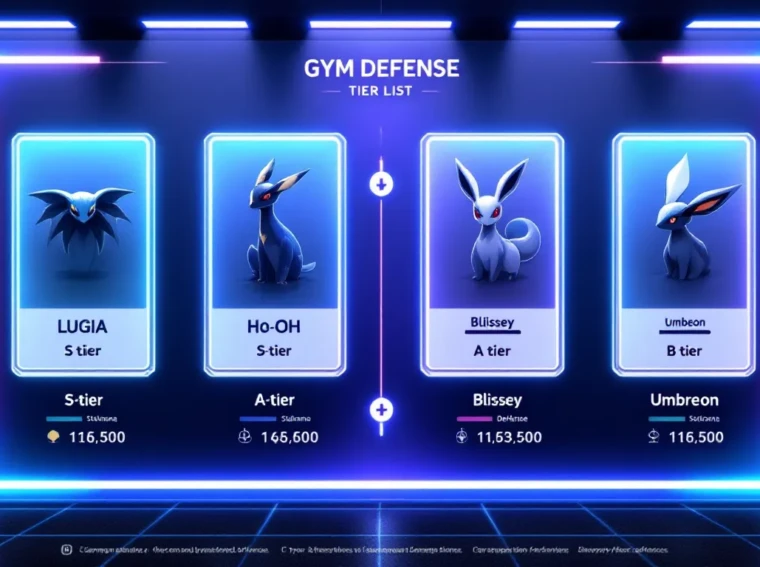
Gym defense in Pokémon GO is a numbers game, and getting it right requires knowing which Pokémon actually hold their ground. Whether you’re defending with Blissey or trying that trending Spiritomb, your choice makes the difference between watching your Pokémon sit pretty for weeks or getting bounced out in hours. This tier list cuts through the noise and ranks every viable defender so you can maximize your gym hold time and get those daily coins without relying on luck or outdated strategies. We’ve analyzed typing, stamina, attack patterns, and the current meta to identify which defenders belong at the top and which ones should stay benched.
Key Takeaways
- Pokemon GO gym defense success depends on stamina, defense, and typing—not attack power—with S-tier defenders like Lugia and Blissey dominating through bulk and favorable type matchups.
- Spiritomb’s Ghost/Dark typing with no true weaknesses and Umbreon’s dark typing resistance make them serious A-tier contenders that frustrate attackers despite mid-range stats.
- A balanced gym defense team requires type diversity across your defenders to force attackers into difficult teambuilding compromises rather than stacking similar weaknesses.
- Gym placement strategy matters significantly: place your strongest defenders in high-traffic urban gyms and experimental defenders in rural locations to maximize coin efficiency.
- Resist common meta attack types (Electric, Water, Fighting) while avoiding multiple simultaneous weaknesses—defenders like Alakazam fail because they’re vulnerable to four different move types.
Understanding Gym Defense in Pokémon GO
Gym defense isn’t about dealing damage, it’s about surviving longer than your attacker’s patience. Defenders don’t attack actively: instead, they gain benefits from time and status conditions, making stamina and bulk far more valuable than offensive stats.
The core mechanics: defenders gain increased damage reduction, and their type matchups matter significantly. A defender weak to common attacking types (looking at you, Fire-types) will crumble fast even though high stats. Conversely, a Pokémon with excellent typing and bulky stats becomes a wall.
Attackers must spend time and resources to defeat your defender. Every extra minute your Pokémon holds the gym costs them potions, revives, and time. This is why Blissey, Umbreon, and similar bulk-focused Pokémon dominate, they’re not spectacular, but they’re exhausting to defeat. You’re not aiming for flashy: you’re aiming for frustration.
One often-overlooked factor: gym placement. A defender in a rural gym might hold for weeks: the same Pokémon in a downtown gym gets destroyed in an hour. This tier list assumes competitive urban or semi-urban gym environments where defenders face experienced attackers regularly.
S-Tier Defenders: The Absolute Best Choices
These Pokémon define the meta and are actively problematic for attackers. They’re not just good: they’re time-consuming nightmares.
Legendary and Mythical Dominators
Lugia remains the gold standard. With 326 stamina and 310 defense, it’s mathematically among the bulkiest Pokémon in the game. Its typing (Flying/Psychic) provides resistance to common attacking types like Fighting and Grass, while its only weakness (Electric) requires specific counter-lineups. Expected hold time: weeks in most gyms.
Ho-Oh sits close behind. Its Fire/Flying typing resists Grass, Fighting, Steel, and Bug attacks, a killer defensive profile. With 298 stamina and 298 defense, it’s slightly less bulky than Lugia but harder to counter-team. Attackers need Rock moves, and not every team carries them.
Mewtwo deserves mention for its sheer stats (270 stamina, 329 defense), but its psychic typing and weakness to common Ghost and Dark attackers make it riskier than Lugia. Still S-tier: just slightly more vulnerable.
These legendaries aren’t just statistically superior, they’re psychologically effective. Attackers see them and often skip the gym entirely.
Bulky Type Specialists
Blissey is the icon for a reason. Its 510 stamina is absurdly high, and Normal typing means it resists nothing but is weak only to Fighting moves. Most casual attacking teams lack strong Fighting options beyond Machamp, and facing Blissey requires either overwhelming firepower or patience. It might not be the “best” defender anymore, but it’s still top-tier due to sheer bulk.
Umbreon has exploded in relevance post-2024. Its Dark typing makes it resistant to Ghost and Dark attacks, the very moves many popular attackers use. With 181 stamina and 240 defense, it’s not the bulkiest, but its typing and move pool create a frustrating matchup. Dark Pulse, Foul Play, and Last Resort make it surprisingly sticky.
Spiritomb has become a serious contender recently. Ghost/Dark typing means it has no true weaknesses, only resistances and immunities. With 210 stamina and 203 defense, it’s mid-tier bulk-wise, but the typing advantage makes it punch above its stats. Attackers often skip Spiritomb because they don’t know how to counter it effectively.
For those wanting A Comprehensive Pokemon GO with broader Pokémon strategies, this foundation applies across all gameplay modes.
A-Tier Defenders: Excellent Gym Holds
A-tier defenders hold gyms consistently and require dedicated counters. They’re not unbeatable, but they demand respect.
Reliable Defensive Types
Talonflame has emerged as an A-tier dark horse since its bulk was improved. Its Fire/Flying typing resists Grass, Steel, Fighting, and Bug. With 182 stamina and 195 defense, it’s outclassed statistically by S-tier options, but its type profile makes it genuinely annoying. Charged Move selection matters here: Brave Bird deals respectable damage on defense.
Gyarados benefits from Water/Flying typing, resisting Fighting, Bug, and Fire while only fearing Electric. With 216 stamina and 196 defense, it holds similarly to Talonflame but requires teams with Electric coverage, a consistent vulnerability.
Cloyster represents Water-type defense done right. Its shell offers extreme defense stats (323 defense) but low stamina (150). Attackers with Electric or Grass moves will burn it down, but casual attackers often lack type coverage.
High HP Contenders
Snorlax is straightforward: massive stamina (330), reasonable defense (146), and only weakness to Fighting. Its bulk makes it tedious to defeat even without exceptional typing. It’s dropped from S-tier only because dedicated Fighting teams crush it, but in gyms without that coverage, it dominates.
Slaking has surprisingly good defensive bulk (230 stamina, 166 defense) even though being Normal-type. Its only weakness is Fighting, and attackers without strong counters struggle. But, Slaking’s mediocre typing keeps it below S-tier.
Milotic brings Water typing with 216 stamina and 219 defense. It resists Steel, Fire, Water, and Ice, a solid defensive spread. Attackers using Grass or Electric will succeed, but those lacking type advantage face a grind.
For those exploring specific Pokémon capabilities in depth, Your Ultimate Thundurus Pokemon Go Guide exemplifies how electrical types perform, and understanding that dynamic helps contextualize why Water and Ground defenders struggle against Electric attacking teams.
B-Tier Defenders: Solid Secondary Options
B-tier defenders work in specific contexts or gym lineups but lack the universal reliability of higher tiers. They’re situational picks, good, not great.
Niche Coverage Picks
Charizard (with Mega considerations in raids aside) offers Fire/Flying typing with decent stats, but its weakness to Water and Rock makes it predictable. Attackers with Water teams specifically counter it within minutes.
Golem serves as a Rock-type specialist with solid defense (229) but weak stamina (160). Specialized Water or Ground teams dismantle it, and many attacking teams include Water coverage as a meta staple.
Porygon2 has unusual Normal typing with a weird defensive profile. Its resistances are minimal, and its stats don’t compensate (216 stamina, 173 defense). It’s useful in niche scenarios but lacks the consistency of B+ defenders.
Arcanine brings Fire typing with 210 stamina and 195 defense. Its weakness to Water, Rock, and Ground is severe in environments where attackers focus on Water teams, and most do. It holds decently but gets countered consistently.
Lapras switches things up with Water/Ice typing, offering resistance to Ice attacks and immunity to Freeze effects. But its weakness to Metal, Rock, Grass, and Electric is enormous. Attackers pack Electric as standard, making Lapras’s bulk insufficient.
Miltank deserves consideration for its bulky stamina (227) and Normal typing, but it shares Blissey’s vulnerability to Fighting and lacks Blissey’s absurd hp, landing it firmly in B-tier.
Understanding defender tier rankings across games helps contextualize meta depth. According to tier list articles from Game8, meta-defining defenders share specific stat and typing patterns that this list follows.
C-Tier and Below: Limited Viability
C-tier defenders lack the stamina, defense, or typing to justify placement in serious gym lineups. They’ll occasionally hold gyms, but experienced attackers burn them down quickly.
Dragonite exemplifies C-tier issues: Dragon/Flying typing offers weak offensive coverage, and its defense (265) doesn’t compensate for weaknesses to Ice, Rock, and Dragon. Attackers carry Ice moves as meta standard, turning Dragonite into a speedbump.
Venusaur and Exeggutor (Grass-types) offer interesting typing but face obliteration from Fire, Flying, and Ice moves that attackers spam in competitive environments. Their stamina is reasonable (207 and 244 respectively), but typing vulnerability outweighs bulk.
Alakazam represents the “high attack, low defense” trap. Even though impressive offensive stats, its 117 stamina and 186 defense crumble instantly. Psychic typing doesn’t help when attackers eliminate it in seconds.
Rapidash, Arcanine, and other mid-tier Fire-types face the problem that every attacker carries Water moves. Gym defense isn’t about flashiness: it’s about lasting. These Pokémon don’t.
Steel-types like Steelix and Scizor seem defensively impressive (extremely high defense stats), but their weakness to common Fire moves and the prevalence of Fire attackers make them liability. Steelix has 150 stamina, criminally low for a defender, regardless of defense value.
Anything below C-tier isn’t worth mentioning. They’re fun experiments, not strategic choices.
Key Defensive Stats and Metrics
Gym defense success hinges on three metrics: stamina, defense, and typing. Understanding how they interact separates informed defender selection from guessing.
Defense and Stamina Importance
Stamina is your primary survival tool. A Pokémon with 250+ stamina forces attackers to throw considerably more attacks. Blissey’s 510 stamina feels absurd because it is, it literally doubles what many defenders offer. Every additional stamina point extends gym hold time.
Defense scales differently. Defense is multiplied by stamina in damage calculations. A defender with 300 stamina and 150 defense will outlast a defender with 150 stamina and 300 defense, assuming matching attack values. This is why stamina generally matters more, it amplifies defense’s effectiveness.
CP doesn’t matter for gym defense once you’ve reached the 1500+ range. A 4000 CP Blissey doesn’t hold longer than a 3000 CP Blissey: both face identical attackers. Don’t waste dust powering up defenders beyond reasonable levels.
The practical defense threshold: aim for 200+ defense on bulky Pokémon. Below that, even high stamina becomes manageable. Spiritomb with 203 defense works because its typing is absurdly good: most defenders with 203 defense would struggle significantly.
Type Coverage and Weaknesses
Typing is your multiplier. A defender with one weakness faces specific counters. A defender with multiple weaknesses (like Alakazam to Ghost, Dark, and Bug) becomes universally vulnerable.
Immunity is gold. Spiritomb’s immunity to Normal and Fighting attacks straight-up cancels two common offensive types. Ghost typing’s immunity to Normal and Fighting makes Spiritomb and Gengar (if you had comparable stats, which it doesn’t) genuinely different animals.
Resistance reduces incoming damage by 20%. A Water-type defending against a Fire attack takes 80% damage instead of 100%. This compounds over dozens of attacks. Water-types defending against Water attacks represent this principle in action.
Weakness multiplies incoming damage by 125%. Fire-types taking Water attacks take 125% damage, catastrophic when attackers stack entire teams around exploiting that weakness.
The meta standard in 2026: Electric attackers dominate against Water-types, Water attackers destroy Fire-types, and Fighting attackers devastate Normal-types. Your defender should resist at least one meta offensive type and avoid weakness to all of them simultaneously. This is why Lugia works, it’s weak only to Electric, allowing attackers to counter-team specifically. Alakazam, conversely, is weak to Ghost, Dark, Bug, and Psychic moves, giving attackers four different paths to victory.
Building a Balanced Gym Defense Team
Gym defense is a team sport. Your Pokémon sit together, and attackers must beat all six (or but many you’ve placed) to clear the gym. Thoughtful team composition forces difficult decisions on attackers.
Synergy and Type Diversity
Type coverage means your defenders shouldn’t all share the same weaknesses. Stacking six Fire-types is actively harmful, one Water attacker defeats your entire team. Distribute defenders across typing.
Good pairing example: Place Lugia (weak to Electric) with Ground-type defenders (Rhyperior, Golem). Attackers must decide: bring Electric to counter Lugia or Water to counter Ground? Neither covers both effectively. This forces teambuilding compromises on their end.
Bad pairing example: Blissey, Snorlax, Slaking (all Normal-types). A single Fighting attacker obliterates your entire composition. Diversity forces attackers to prepare more.
Starter slot matters. Attackers often battle Pokémon in order. Placing your strongest defender first (usually Lugia or Ho-Oh) intimidates less-committed attackers into skipping the gym entirely. Pragmatically, that saves your Pokémon from fighting at all.
Later slots should include varied types. Position Water-types after Fire-types to punish Fire attackers. Ghost-types after Psychic attackers’ main targets deter them from continuing.
Regional and Meta Considerations
Meta shifts occur with balance patches and seasonal events. In early 2026, Fairy-types haven’t become defensive staples even though Dragon-type prevalence, but this could change. Stay adaptable.
Regional availability matters. If Ground-types are common in your region, fewer attackers have Water coverage, Ground-types are weak to Water. Adjust accordingly.
Seasonal events introduce temporary meta shifts. During Dragon-type events, Fairy or Ice attackers become more common. Your defender placement should acknowledge current event focus.
For comprehensive understanding of Pokémon mechanics and meta evolution, tier lists from Pocket Tactics cover similar meta analysis principles applicable across strategies. Also, consulting Twinfinite’s guide collections provides broader context on game balance updates that affect defender viability over time.
Gym location analysis: Rural gyms with less traffic can hold defenders indefinitely, place experimental or lower-tier defenders there. Urban gyms with high turnover need S-tier defenders only. Your Pokémon will get defeated: allocate resources accordingly. Defending a downtown gym for three days is worth more than defending a remote gym for three weeks when considering gym coin efficiency.
Coordinate with teammates. If your team controls a gym, diversify to cover each other’s weaknesses. If you’re defending alone, maximize individually, place your best defenders regardless of what’s already there.
Conclusion
Pokémon GO gym defense hinges on stamina, defense, and typing. S-tier defenders like Lugia, Ho-Oh, and Blissey define the meta through sheer bulk and favorable typing. A-tier options provide consistent hold time with less intimidation value. Below that, defenders face vulnerabilities that competitive attackers exploit consistently.
Your defender tier list should evolve as the meta shifts, patches alter move pools, seasonal events change attacker compositions, and new Pokémon additions reshape viability. The principles remain constant: prioritize bulk, resist common attack types, and avoid stacking weaknesses.
The most successful gym defenders aren’t flashy. They’re frustrating. They’re walls that make attackers sigh and consider skipping the gym entirely. That’s the real win, not a spectacular defender, but one that decides attackers’ time isn’t worth the reward. Build accordingly.